
Fort WorthAutomatic Gate Repair

Residential & Commercial

Automatic Gate Repair Fort Worth

A gate that won't open or won't close is a problem with a specific cause. Finding it takes an inspection.

Automatic gate repair for homes and commercial properties across Fort Worth and DFW — gate structures, operators, and access control. Licensed and insured, over a decade in business, and estimates are free.

Below is a plain explanation of what commonly goes wrong with automatic gates and what each symptom can point to. It won't tell you which one is yours. It will tell you what you're dealing with, so the conversation you have next is an informed one.

  • Free estimates
  • Licensed and insured
  • Over a decade in business
  • Residential & commercial

Request a free estimate

Tell us what the gate is doing and we'll get back to you.

Free estimates. Licensed and insured.

Do this first

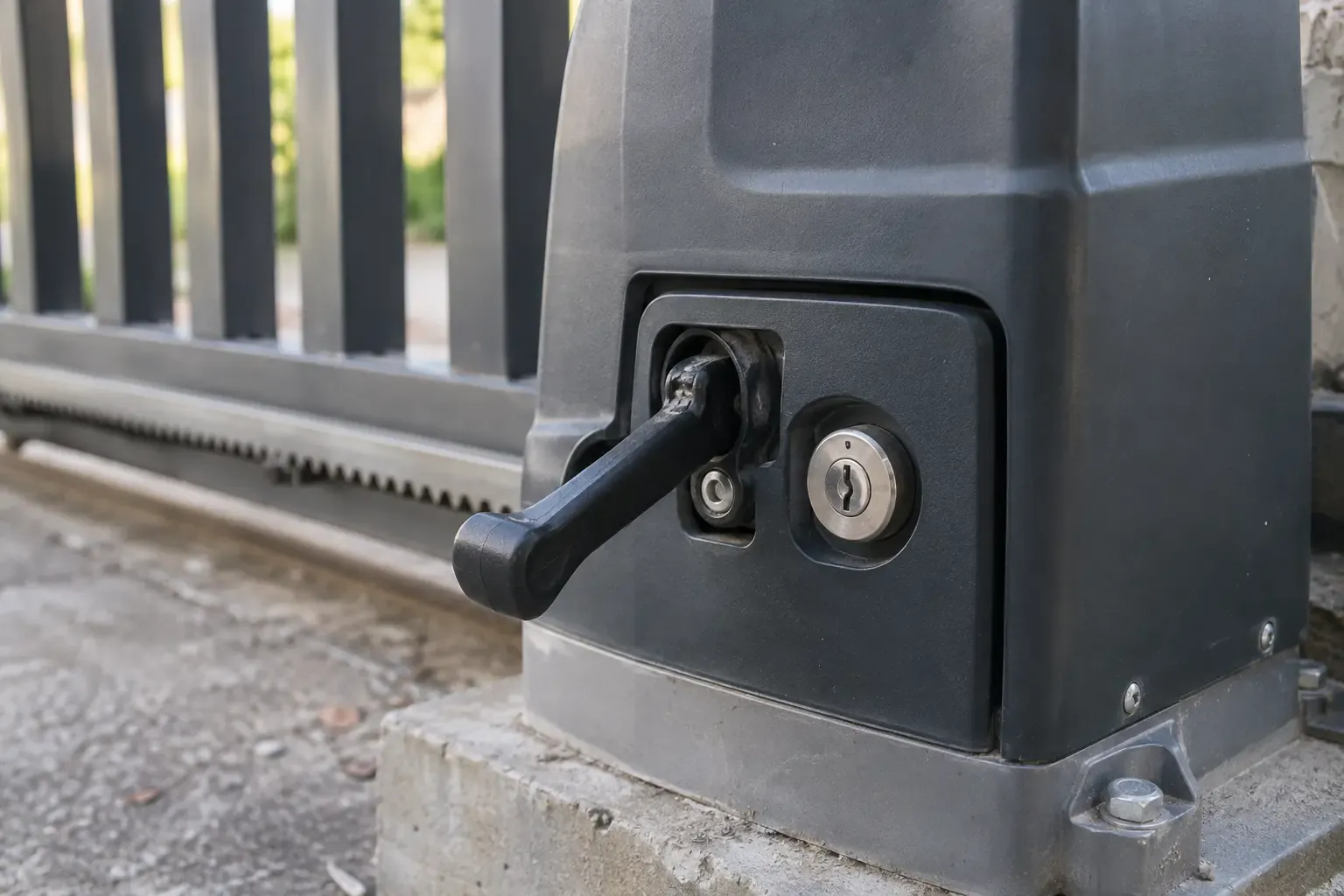
It's free and it takes ten seconds. Check the manual release.

If someone disengaged the operator to move the gate by hand and never re-engaged it, the motor runs and the gate sits there. It's the one cause you can rule out yourself, from where you're standing.

Still not moving? Then look at the symptoms below.

The manual release lever on a gate operator, shown in the disengaged position with the linkage to the drive visible.

Find your symptom

Six symptoms, and what each one can point to

Each has more than one possible cause — that's the honest picture, and it's why the list stops at possibilities.

  • The gate opens but won't close.

    It starts, stops, and rolls back open. A gate that reverses on close may be responding to a safety input — a misaligned or dirty photo-eye, a control board that lost its settings, or a failed sensor. Check the beam path for spiderwebs, mud, or a shifted bracket.

  • It hums but doesn't move.

    The motor is getting power and something downstream is stopping it. The drive assembly, the gate binding on its track, or the motor's start components. The hum tells you power is arriving. It tells you nothing about what's blocking it.

  • Nothing happens at all.

    No hum, no lights, no response. That points at power somewhere in the chain — a tripped breaker, a dead battery, a failed transformer, or a board that isn't waking up. Start at the breaker. That one's free to check.

  • It stops halfway.

    Something is telling the operator it has arrived when it hasn't. The limit switch is what defines “fully open” and “fully closed”; if it drifts, the gate stops short. So can an obstruction, a binding gate, or a board that lost its travel settings.

  • The remote doesn't work.

    Could be the remote. Could be the receiver. Could be the power supply feeding it. Three different repairs, and from the driveway they look identical.

  • The gate is dragging or grinding.

    On a slide gate, rollers and track. On a swing gate, hinges or a frame that's sagged out of square. We repair both, including welding a cracked frame or post on site.

Sorting a possibility into a cause means looking at the gate. Call {{PHONE_NUMBER}} and describe what it's doing.

What the work involves

What automatic gate repair actually covers

"Gate repair" gets used as though it's one job. It's really three different disciplines that meet at your driveway.

  • Structural

    The gate itself — frame, hinges, posts, track, rollers. This is fabrication and welding work. A gate that sags, drags, grinds, or has cracked at a weld is a structural problem, and adjusting the operator won't fix it.

  • Mechanical

    The operator — the motor and drive assembly that physically moves the gate. Bearings, drive components, mounting. A machine doing repetitive heavy work outdoors.

  • Electrical

    Control boards, power supply, safety inputs, and the access-control equipment that tells the gate to open in the first place.

A single symptom can originate in any of the three. That's why the diagnosis matters more than the label — "my gate is broken" doesn't identify which discipline is involved, and those are different repairs with different scopes.

Two audiences

Residential and commercial gates are different problems

Same technology, different failure profile, different stakes.

Residential driveways

Your gate is the thing you stop thinking about until the morning it strands you in your own driveway. A residential gate runs a limited number of cycles a day, and a failure is often confined to a single component — a sensor out of alignment, a battery at end of life, a roller worn flat.

What you want to avoid is paying to replace a structure that never broke.

Apartments, HOAs, self-storage, industrial

A commercial entrance runs far more often, and every cycle is wear. Higher cycle counts change what wears and how quickly. They also change the stakes: a stuck-open gate at a storage facility isn't a maintenance ticket, it's an open property until it's fixed. A stuck-closed gate at an apartment blocks the entrance for everyone using it.

When a commercial entry fails, the tenant calls come to you.

Gate types

Sliding gates and swing gates fail differently

Which type you have changes what to look at first.

Sliding gates

Carry their weight on rollers and a track. Mechanical failures tend to involve that path: rollers wearing or seizing, track collecting dirt and debris, the gate coming off track, or a frame twisted enough that the roller no longer sits square. Because the track is fixed to the ground, anything that moves the ground can affect its alignment.

Swing gates

Hang their entire weight on hinges. That load is constant, so failures show up at the hinge and the post — sagging, binding, cracked welds where the hinge meets the frame. A swing gate scraping an arc into the driveway has dropped.

Both types use the same categories of operator and the same access control. The gate structure is where they diverge, and it's usually where the visible symptom starts.

Gate vs. operator

Before you replace your gate, find out which half broke

They fail differently, they're diagnosed differently, and they cost differently. A component inside the operator and a rebuilt entrance are not the same job — and which one you're facing is what an inspection settles.

So if you've been quoted a full gate replacement and nobody tested the operator, get a second opinion. That quote may be right. It also may be a structure being replaced because a machine failed.

A proper inspection can determine whether the problem is in the gate structure, operator, or another part of the system.

The gate

Steel, hinges, and hardware.

A structure.

The operator

A motor, a control board, and a battery.

A machine with moving parts and electronics.

Repair or replace?

It depends on where the failure sits and what condition the rest of the system is in. An operator that has stopped working isn't automatically an operator that needs replacing — the failure can be a component inside it. A gate frame cracked at one weld is a welding repair, not a new gate.

What moves a job toward replacement is usually accumulated condition rather than the single visible symptom: a structure repaired repeatedly, a frame out of square in several places, or an operator undersized for the gate it has been moving since installation.

That judgment requires seeing the gate.

Capabilities

What we repair

  • On the gate

    Hinges, tracks, rollers, and structural welding — cracked or broken frames, hinges, and posts, welded on site.

  • On the operator

    Motors and control boards. Repaired, replaced, or installed.

  • Access control

    Keypads, card readers, telephone entry systems, and intercom systems, installed and repaired.

  • Gate types

    Sliding and swing gates. Residential driveways and commercial entries.

We also install automatic gates and build custom gates.

Motors and control boards

The operator is where the gate stops being a fence and starts being a machine. The motor does the physical work; the control board is the logic that decides when to run it, how far to travel, and when to stop. Many electronic symptoms — a gate that stops halfway, one that ignores a remote, one that opens but won't close — involve the board reading an input, or losing the settings it needs to interpret one. We repair, replace, and install both.

Hinges, tracks, rollers, and structural welding

These are the parts that carry weight, and weight is relentless. Hinges take the entire load of a swing gate. Rollers and track carry a slide gate and collect whatever is on the ground. Welds hold the frame square.

We repair and replace hinges, tracks, and rollers, and we weld structural gate components on site — cracked or broken frames, hinges, and posts. On-site welding matters for a heavy motorized gate, because the alternative involves removing a structure that is fixed into the ground on a live entrance.

Automatic gate installation and custom gates

We install automatic gates and build custom gates. A new gate is a specification problem before it's a fabrication problem: the operator has to be sized for the weight of the gate it moves, and the entrance has to be able to power it. An operator undersized for its gate works harder on every cycle for the life of the installation.

Access control and intercom systems

Access control is how the gate knows to open — and on a commercial property, who is allowed through it. We install and repair keypads, card readers, telephone entry systems, and intercom systems.

This equipment is what a resident, tenant, or visitor actually touches, which makes it a common source of reported problems on a multifamily property even when the gate and operator are working correctly. A gate that won't open for a delivery driver may have nothing wrong with the gate itself.

Because we install this equipment as well as repair it, a failed entry system doesn't have to become a second contractor and a second appointment.

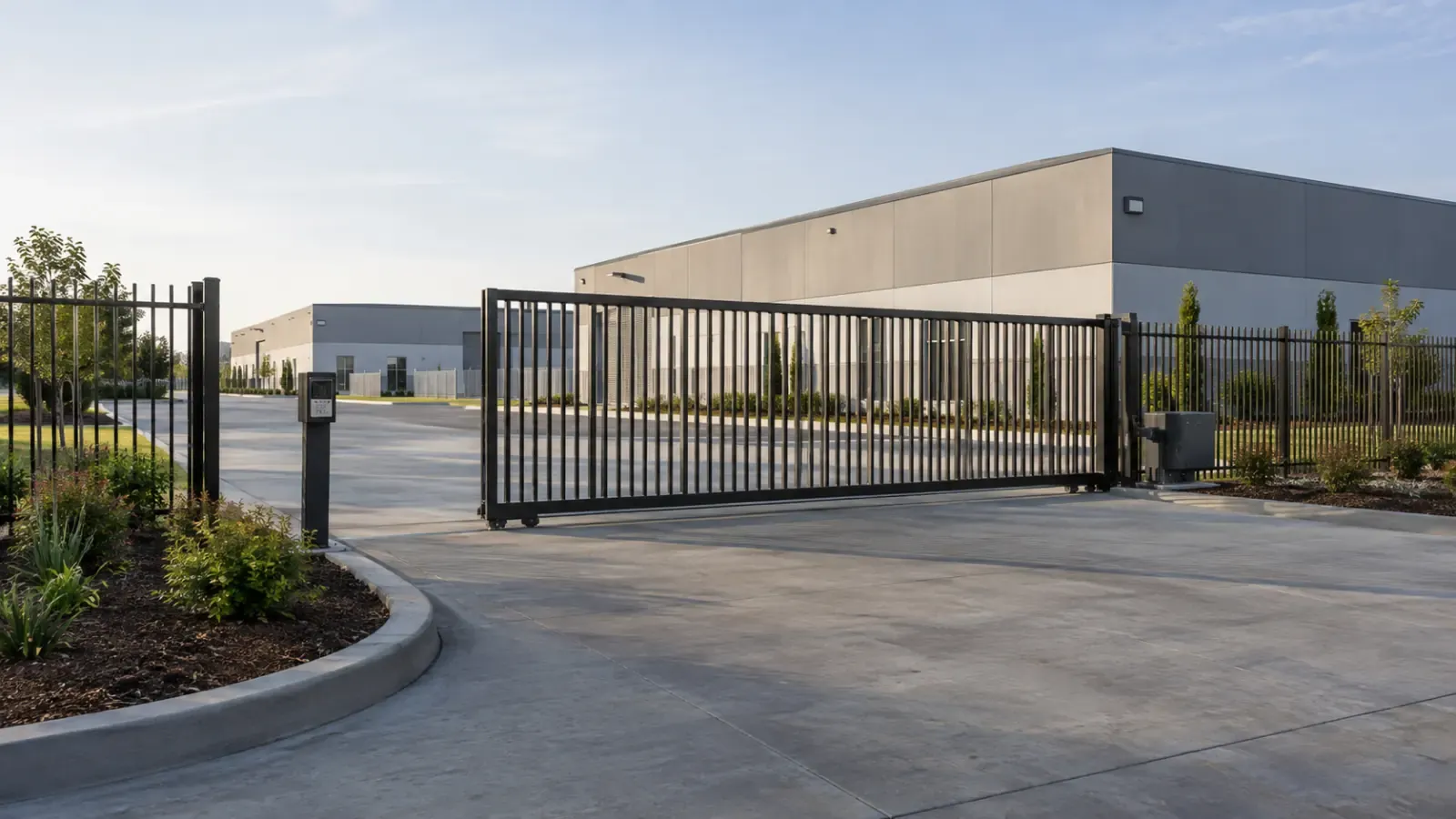
A powered slide gate across a commercial property entrance, with the operator mounted beside the track.

Commercial & multifamily

A stuck-open gate at a storage facility isn't a maintenance ticket.

It's an open property until it's fixed.

When the entry gate fails, the tenant calls come to you. You need someone who can look at the system, identify what failed, and describe it clearly enough that you can put it in a work order and justify it to an owner.

We're licensed and insured, and we've been doing this in DFW for over a decade.

  • Apartment & HOA entries
  • Self-storage gates
  • Industrial & commercial facilities
Call {{PHONE_NUMBER}}

Emergency situations

Not every gate failure is an emergency. Some are.

  • The gate is stuck open.

    The property is unsecured until it's closed. On a storage facility or apartment complex, that exposure continues every hour it stays that way.

  • The gate is stuck closed.

    Nothing gets in or out — including, at a commercial property, emergency vehicles.

  • Something hit it, or the weather did.

    Vehicle impact and storm damage tend to produce structural damage rather than electronic failure, and a gate that has been struck may be unsafe to operate even if the operator still runs. A bent frame on a powered gate is a moving hazard.

What to do first

Find the manual release and get the gate to a safe position — closed if the property needs securing, open if vehicles need to move. Then stop operating it. Running a gate that is binding, dragging, or structurally damaged can turn a repair into a larger one.

Emergency gate services are something we offer. Call and describe what happened.

Call {{PHONE_NUMBER}}

Cost

What drives the cost, and what to know before you request an estimate

Nobody can responsibly quote a gate they haven't seen. What can be explained is what moves the number.

  • Which part failed

    A misaligned photo-eye, a failed control board, and a cracked frame that needs welding are three different jobs.

  • Repair or replace

    Whether the failed part is repairable changes the scope.

  • Gate type and access

    A heavy commercial slide gate on a busy entrance is a different working environment from a residential swing gate.

  • Site conditions

    Power at the entrance, drainage, ground movement, how the gate is mounted.

  • Access control

    Whether the entry system is part of the problem.

Before you call, it helps to have

  • What the gate is doing, in plain words.
  • Whether it's a slide or a swing gate.
  • Roughly how long it's been happening, and whether anything changed just before — a storm, a power outage, vehicle contact, or work done by someone else.
  • Whether the operator has been serviced before.
  • If you already have a quote, what it says.

None of that is required. It shortens the conversation.

The honest answer

Several of these symptoms have more than one cause

That's why the lists above name possibilities instead of verdicts. A gate that stops halfway and a gate that reverses on close can each come from the operator, the gate structure, or the electronics — and those are different repairs.

Sorting that out means looking at the gate.

Estimates are free.

Common questions

Gate repair questions we get asked

What are the common problems with automatic gate openers?

Most calls trace back to a short list of parts. Safety photo-eyes that drift out of alignment or get blocked by mud and spiderwebs. Limit switches that lose the position they use to define fully open and fully closed. Control boards that lose their settings. Power problems — a tripped breaker, a dead battery, a failed transformer. And on the mechanical side, worn rollers, a gate binding on its track, or hinges and frames that have sagged out of square.

The catch is that one symptom can come from several of these. A gate that reverses on close and a gate that stops halfway can each originate in the operator, the gate structure, or the electronics — and those are different repairs.

What is the average lifespan of an automatic gate opener?

There is no single number that holds across installations, because the things that determine it vary enormously from one gate to the next.

Cycle count is the biggest factor. An operator at a self-storage or apartment entrance runs many times a day; a residential driveway operator may run a few. Weight matters too — an undersized operator moving a heavy gate works harder for every cycle. So does whether the gate itself rolls freely: a binding track or a dragging hinge makes the motor fight the gate on every open and close.

That is also why an operator that has stopped working is not automatically an operator that needs replacing. The failure is often a component within it.

How much does it cost to service an electric gate?

For general scale, published industry estimates put automatic gate repair at roughly $550 to $1,500. That is a third-party figure, not our pricing, and it is national — it is useful for setting expectations and nothing more.

What your gate actually costs in Fort Worth depends on which part is at fault. A misaligned photo-eye is a different job from a failed control board, which is a different job again from a cracked frame that needs welding. Whether the part is repaired or replaced changes it. So does access, gate type, the access-control equipment involved, site conditions, and whether the problem is in the gate structure or the operator.

The only pricing commitment we make is that our estimates are free. If someone quotes you a firm price for a gate they have not inspected, they are guessing at which of those it is.

How much does a gate cost to repair?

Same general range — industry sources put gate repair around $550 to $1,500 — and the same caveat: that is a third-party national estimate, not a quote from us. The repair is priced by the failure, and the failure has to be identified first.

The useful distinction to understand before you get any quote is gate versus operator. The gate is steel, hinges, and hardware — a structure. The operator is a motor, a control board, and a battery — a machine with moving parts and electronics. A component repair and a rebuilt entrance are very different pieces of work, and which one you are looking at is exactly what an inspection determines.

A component repair sits at one end of that range and a rebuilt entrance sits well past it. Our estimates are free. And if you have been quoted a full gate replacement without anyone testing the operator, get a second opinion.

What is the average cost of an automatic gate?

Published national figures for automatic gate installation run roughly $2,380 to $8,000, with an average near $4,000. Texas-specific installation figures run wider — roughly $3,000 to $12,000 depending on scope. Those are third-party industry estimates, not our prices.

The spread is that wide because a custom fabricated gate, the gate's size and material, the operator specified for its weight, the access-control equipment, and the electrical and site work at the entrance all move the number independently. A single-swing residential driveway and a gated apartment entrance are not the same project.

We install automatic gates and build custom gates. Our only pricing claim is free estimates — and for a new gate that estimate is the only figure worth acting on, because it is built from your entrance rather than from a national average.

Still not sure what you're dealing with?Call {{PHONE_NUMBER}} and describe what the gate is doing. Estimates are free.

Stuck right now

If the gate is stuck open, your property is unsecured until it's closed.

If it's stuck closed, you're not getting a vehicle in or out.

Call {{PHONE_NUMBER}}

Local conditions

An automatic gate lives entirely outdoors

North Texas conditions are worth understanding as context — not as a diagnosis of any particular gate.

The ground moves here

Much of the Fort Worth–Dallas area sits on the Blackland Prairie, where the USDA's soil survey rates shrink-swell potential asvery high. These clays contain minerals that absorb water between their layers and force them apart, so the soil expands when wet and contracts when it dries. Rainfall makes that a repeating cycle rather than a one-time event: the National Weather Service records annual precipitation at DFW ranging from under 20 inches to more than 50, unevenly distributed through the year.

Gate posts, track foundations, and hinge posts are all fixed into that ground. Where a post shifts, the geometry it was set to holds no longer — which is one of several things that can put a slide gate's track out of alignment or drop a swing gate on its hinges.

The summers are hard on outdoor equipment

The NWS describes the DFW climate as humid subtropical with hot summers, noting that in July and August daytime temperatures are "consistently in the 90s, often reaching or exceeding 100 degrees." DFW averages 18 days a year at 100°F or above.

Gate operators house electronics and, in many installations, a battery — and both are components that manufacturers rate for a temperature range. Equipment mounted in full sun sits in an enclosure hotter than the air around it.

Storms arrive fast

The NWS notes that brief afternoon and evening thunderstorms account for the bulk of summer rainfall in North Texas, usually on days that are otherwise sunny and hot.

Storms bring the things that damage gates directly — wind loading on a large gate panel, debris in a slide gate's track, and power interruptions that leave a gate running on battery backup.

None of that means the weather broke your gate. It means an outdoor machine anchored in ground that moves, in a climate with real temperature and moisture swings, is working in conditions worth accounting for. Which of those applies to your gate is a question for an inspection.

Fort Worth and DFW

Gates in Fort Worth and DFW

We service automatic gates in Fort Worth and across the DFW area — residential driveways, apartment and HOA entries, self-storage, and commercial facilities.

Licensed and insured. Over a decade in business. Free estimates.

Call {{PHONE_NUMBER}} and describe what the gate is doing. Or send the details and we'll get back to you.

Send the details

Tell us what the gate is doing and we'll get back to you.

Free estimates. Licensed and insured.

Call {{PHONE_NUMBER}}