
Residential Driveway Gates · Sliding & Swing
Automatic Gate Repair in Fort Worth
Your gate is a structure and a machine bolted together. When something goes wrong, the first useful question is which of the two failed — because they fail differently, they're diagnosed differently, and one of them regularly gets blamed for the other.
Free estimates · Fort Worth and the DFW area
Request a free estimate
Tell us what the gate is doing and we'll get back to you.
How gates fail
Gates almost never fail all at once
By the time a gate stops working, it has usually been telling you something for months.
A gate that quit this morning after a year of grinding doesn't have a one-day-old problem — it has an old problem that finally crossed a threshold. A repair addressing only this morning's symptom leaves the cause running.
Gates degrade gradually because most of what holds a gate in position is under constant load. A closed swing gate still hangs on its hinges at three in the morning; a parked slide gate still rests its full weight on its rollers. Wear accumulates continuously — but you only watch the gate during the few seconds a day it moves.
Each stage is a chance to fix a smaller problem than the one after it.
Scope
Three families of cause, and which one this page is about
"Gate repair" gets treated as a single job. It's really three, and they meet at your driveway.
This page
Structural
Everything that carries the gate's weight and holds its geometry — and it fails slowly, under load, at the joints where those two jobs meet.
Overlaps
Mechanical
The parts transferring force between operator and gate, plus the surfaces the gate rides on. Overlaps with structural at rollers and hinges.
Different page
Operator & electrical
The motorized unit and its electronics, failing the way machines fail — often suddenly. That's gate opener repair.
The connection that makes this boundary useful: the operator is specified to move a gate that travels freely, and it has no way to know why the gate is hard to move — only that it is. When the structure degrades, the operator absorbs the difference and works harder every cycle.A structural problem very often reports itself as an operator complaint.
The structure sets the load, and the operator lives with whatever the structure hands it.
Misattributed faults
When the gate is the problem but the opener gets blamed
Some patterns point at structure even though what you observe is the operator misbehaving.
- It stalls at the same place every time
- Operators have no preferred failure location. Structures do — a repeatable stall point means something at that spot in the path is wrong.
- It's slower in one direction
- Gravity and geometry are directional. Electronics generally aren't.
- The gate is hard to move by hand
- Release the operator, and if the gate still fights you, the operator was never the problem.
- A new operator didn't fix it
- A working machine installed into a binding structure reproduces the original complaint, because it starts life fighting the same drag.
- It's gotten louder over months
- Electrical faults rarely announce themselves gradually in sound.
None of that diagnoses your gate — it describes what these patterns can indicate, which is what an inspection confirms or rules out.
Gate type
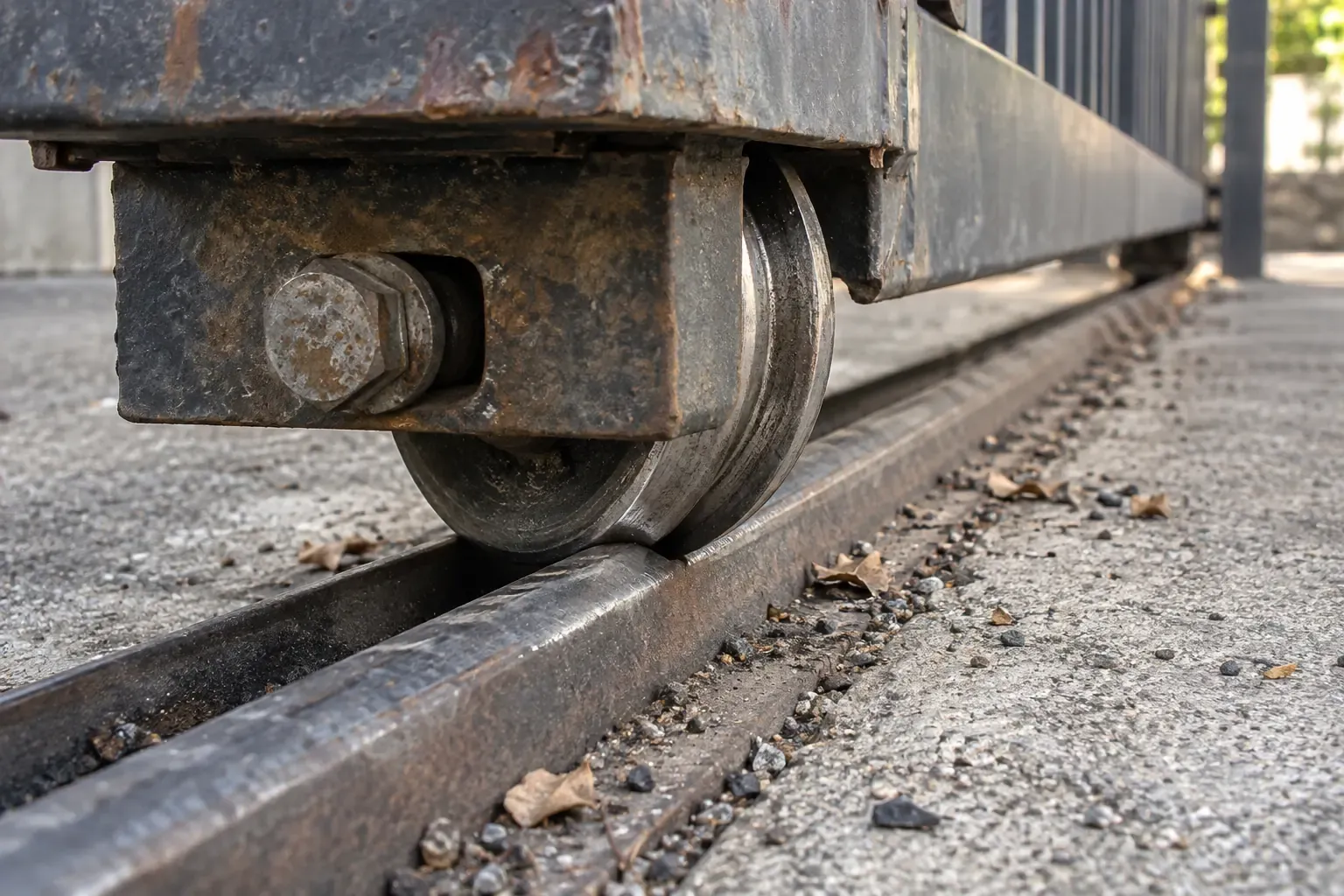
Sliding gates: the roller path
A slide gate doesn't hang. It rolls, and nearly all of its structural problems live somewhere along one path.
That path has three parts that each depend on the other two being right: the rollers that carry the load, thetrack they run in, and the framethat holds the rollers square to the track.
How it degrades
The track sits at ground level, so it collects grit, gravel, leaves, mud, and runoff. Debris doesn't just obstruct; it grinds. A roller running repeatedly over compacted grit wears flatter on one side, and a roller that is no longer round skips rather than rolls.
- Debris collects in the track
- A roller wears flat on one side
- The flat roller skips instead of rolling
- Skipping puts sideways force into the frame
- The frame racks out of square
- A racked frame angles the next roller — which now wears too
That's where one problem becomes several. A roller loaded at an angle wears faster than one loaded straight down. A debris problem has become a frame problem and a second roller problem.
How it presents
Noise first, usually a rumble or grind. Then uneven travel — fine across most of the opening, laboring at one point. Then straining there. Then the gate comes off track.
Coming off track is a symptom, not the failure
A gate leaves its track because something let it — a worn roller, a bent or obstructed track, a twisted frame, or a track that has moved. Lifting a gate back onto its track without establishing which of those applies is the clearest example of fixing the symptom and leaving the cause running.
What an inspection looks at
Whether rollers turn freely and hold a round profile; whether the track is clear, straight, and still fixed where it was set; whether the frame is square — cleaning a track never corrects a roller that isn't sitting flat in it. And whether the track'sfoundation has moved, which is a different finding from track damage.
What we do
Repair, replace, and install rollers, tracks, and hinges, including track realignment. Where the frame itself has cracked or pulled, we weld it structurally on site.
Gate type
Swing gates: hinge load and the post
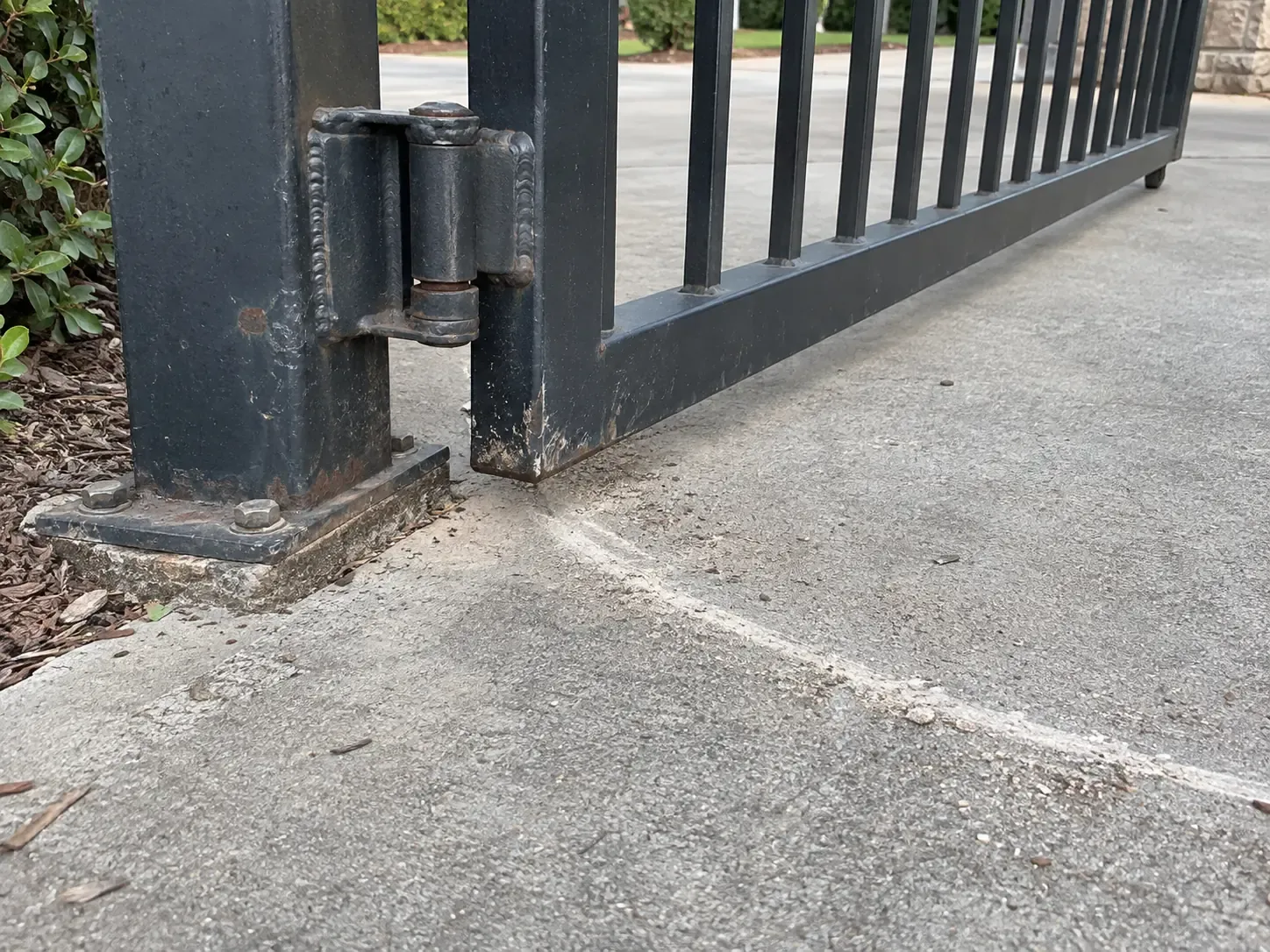
A swing gate has no track. Its entire weight hangs on its hinges, and everything that goes wrong follows from that.
The load is constant, and it isn't only weight — it'sleverage. The far edge sits several feet from the pivot, so the gate acts as a lever arm: a gate of modest weight applies substantially more force at the hinge than it weighs, and that force transfers straight into the post.
How it degrades
Three things absorb that leverage: the hinge, the weld or fastening where the hinge meets frame and post, and the post's grip in the ground. Whichever is weakest gives first — the hinge wears oval, the weld cracks, or the post rotates slightly in the soil.
All three produce the same visible result: the leading edge drops
That's what sagging is — not the gate bending, but the pivot losing its position. So "the gate is sagging" is one symptom with at least three distinct causes and three distinct repairs.
The cascade
Once the leading edge drops, the gate stops swinging level and drags. That adds friction the hinges never carried, at the worst possible leverage — so the sag accelerates the wear that caused it, and loads the operator, which is now pulling a gate across concrete.
How it presents
A scrape arc across the driveway, measuring exactly how far the gate has dropped. Binding at the latch. Not closing fully. Needing a lift to start moving. An uneven gap at the closed gate.
What an inspection looks at
Hinges, welds at frame and post, whether the post is plumb, and whether the frame has racked. A long-sagging gate usually has more than one, because each loads the next.
What we do
Repair, replace, and install hinges. Weld cracked or broken frames, hinges, and posts structurally, on site.
Structural welding
What cracked welds do to a gate that still works
A cracked weld rarely announces itself. The gate keeps operating, which is precisely the problem.
A gate frame is a set of members holding each other at fixed angles, and the welds maintain those angles. When one cracks, the frame doesn't fall apart — it becomes slightly flexible at that joint, and starts changing shape while it moves: square at rest, out of square under the load of travel.
That produces symptoms that seem to make no sense. A gate that measures fine but binds anyway. One that catches moving in only one direction. A slide gate whose rollers wear unevenly for no visible reason, because the frame presents them differently under load than at rest.
It also worsens on its own: a cracked weld concentrates stress at the crack tips, so continued cycling extends it. And the load that joint stopped carrying went somewhere — into the fasteners and hinges at the other joints.
Why on-site welding matters
A motorized gate is fixed into a working entrance. Shop work means removing that structure from a live driveway and leaving the entrance open until it returns. We weld cracked and broken frames, hinges, and posts at your property.
On scope
Welding is a repair capability — how a structure is returned to sound. New gates are separate work, and we install automatic gates and build custom gates as well.
Physical damage
Vehicle impact and physical damage
A gate that has been struck rarely tells the whole truth from the outside.
Steel redistributes impact well. Force delivered to a panel travels through the frame into the hinges or rollers and into the post, so the visible dent may be nowhere near the structural damage. A gate that looks cosmetically fine after a bump can have a bent hinge, a cracked weld, or a post moved a fraction of a degree — and because it still operates, that goes undiagnosed until the new geometry starts wearing something. The reverse happens too: a badly dented panel with the structure intact, where the repair is smaller than it looks.
Impact damage needs an assessment of alignment and pivot integrity, not just panel condition.
If your gate is stuck open or stuck closed right now and the property is exposed, that's emergency gate repair.
Fort Worth ground conditions
Water, drainage, and the ground under the gate
The ground is part of the structure. It's the part nobody inspects.
Drainage first, because it's the most actionable
A gate at the low point of a driveway receives the water the driveway sheds — for a slide gate, silt and grit delivered into the track repeatedly, which is the input to the wear chain above; for a swing gate, soil around the post that spends more time saturated than soil elsewhere. Standing water at a post base, or a track that silts up after every rain, is worth mentioning when you call.
Then the soil, which here is unusual
Much of the Fort Worth–Dallas region sits on Blackland Prairie clays. The USDA's Official Series Description for Houston Black — the classic soil of this region — records40 to 60 percent clay and shrink-swell behavior producing cracks a half-inch to four inches wide at twelve inches deep during dry periods.
Read that as a structural fact, not a soil fact. Ground that opens four-inch cracks has changed volume substantially, and gate posts and track foundations are set into it. A four-year instrumented study of North Texas expansive clay (Hossain et al., TRB 2016) measured the moisture variation zone — the depth through which seasonal wetting and drying actually moves soil — at about3.6 metres, roughly twelve feet. Most gate posts sit nowhere near that deep, so the bulk of a typical post is in soil that moves seasonally.
The consequence is geometry. A post doesn't need to fall over to break a gate, only to change angle — and a swing gate amplifies that through its lever arm, so a post rotating a fraction of a degree moves the far edge visibly. A slide gate's track only needs supports that rise or settle unevenly to develop a hard spot where there wasn't one last year.
This is why seasonal symptoms matter, and why realigning a track without asking why it moved tends to be temporary — you're correcting alignment to a position the ground is still moving.
Contributing factors
Other things that shorten structural life
Not everything is climate, and several of these are decided the day the gate is installed.
Original installation
A gate is a system in balance — gate weight, post size and depth, hinge capacity, track support, operator capacity. If any element was undersized for the gate it serves, the structure carries stress from day one, and a post set too shallow for local soil is more exposed to the movement above. A gate hung slightly out of plumb, or a track set slightly out of level, never announces itself; it just wears unevenly, forever.
Cycle count
Every cycle is wear, so two identical gates won't be in identical condition if one runs a few times a day and the other constantly. One reason commercial entrances are a distinct problem.
Corrosion
Rust matters when it's through material rather than on it. Surface rust on a painted panel is cosmetic; corrosion at a weld, inside a hinge barrel, or at a post base where it meets soil and water is structural, because it removes material where load is carried.
Running it while it binds
The most damaging, because it's easiest to keep doing. Every cycle forces the structure past resistance, and that force lands on whichever joint is weakest. A track never cleared and a hinge never looked at fail earlier than they need to for the same reason.
Before it fails
Warning signs, and what you can safely check
Signs worth acting on
- A new sound, or a sound with a specific location in the travel
- Hesitation, slowing, or straining at one repeatable point
- A scrape arc on the driveway, or a gap at the closed gate that used to be even
- Debris or standing water accumulating in the same place after rain
- Rust at a weld, hinge, or post base rather than on flat panel
- Symptoms that come and go with weather or season
- Any repair already done twice at the same place
Safe to observe yourself
Watch the gate attempt its full travel and note whereanything changes. Look for the scrape arc, uneven gaps, standing water, and track debris. Then, with the operator released per its manual, move the gate by hand and feel for resistance — whether it's smooth, and where it isn't.
That last one is the most useful observation a homeowner can make, because it separates structure from operator before anyone arrives.
Needs an inspection
Anything requiring you to hold, lift, or support a gate; anything involving the operator, its wiring, or its power; judging whether a post has moved or a frame is square.
Gates are heavy, they store energy unexpectedly when out of alignment, and a gate that has been binding is a gate under load.
Decision guidance
Repair, or replace?
The visible symptom is where the failure surfaced, not usually where it started.
A gate off its track surfaced at the roller but may have started at a foundation that moved. Correcting only the surface produces the same repair again, on a schedule set by whatever is still driving it. It's also the honest reason we won't tell you what's wrong over the phone: which link in that chain is yours is a question for an inspection.
There's no policy answer to repair-versus-replace either. There are factors, and they resolve on site. Broadly, four outcomes:
Adjustment or correction
Alignment, clearing, resetting a component to position. Appropriate when nothing has failed structurally and geometry is recoverable — and durable only once the reason it moved is understood.
Component repair or replacement
One locatable failure on a sound structure: worn rollers, a hinge, a damaged track section.
Structural repair
Cracked welds, a broken hinge mount, a frame out of square, a post needing re-setting. Welding and structural work on a gate worth keeping.
Whole-gate replacement
Reasonable when accumulated condition, not one symptom, is the problem.
Points toward repair
- Damage confined to one location
- A frame otherwise square
- Sound material
- A post still plumb and firm
- A gate that moves freely by hand once the fault is corrected
Points toward replacement
- A frame out of square in several places
- Corrosion through material at multiple load-bearing points
- Repairs stacked on previous repairs at the same joints
- Damage spread across enough locations that repairing each one rebuilds most of the gate anyway
What should not decide it: an operator failure
One of them failing says very little about the other's condition. If a quote for a complete new gate arrived without anyone moving the gate by hand, that judgment was made without the one test that separates the two systems. Sometimes replacement is right. Sometimes the steel was never the thing that broke.
Our estimates are free, so the second opinion costs nothing.
What an on-site inspection has to establish
Beyond the component checks named in each section above, two findings decide whether a repair holds:
- Whether a foundation moved, as distinct from a track or post being damaged
- Whether the visible symptom is the cause or a downstream consequence
Those are the two most often skipped. The rest — hand movement, frame square under load, hinge and weld integrity, post plumb, roller profile, whether the structure is loading the operator, and whether corrosion is surface or structural — follows from them.
Verified capabilities
What we repair on the gate
- Hinges
- Repair, replacement, and installation, including structural welding
- Tracks
- Repair, replacement, installation, and realignment
- Rollers
- Repair, replacement, and installation
- Structural welding
- Cracked or broken frames, hinges, and posts, welded on site
- Sliding and swing gates
- Residential driveways and commercial entries
We also install automatic gates and build custom gates.
Not on this page
Gate motors and control boards are covered under gate opener repair. Keypads, card readers, telephone entry, and intercom systems are covered under access control — we install and repair all four.
Not what you're looking at?
Where to go next
The motor runs but the gate doesn't move properly, or nothing responds at all
Gate opener repairThe gate is stuck open or stuck closed right now
Emergency gate repairThe keypad, intercom, or entry system is the problem
Access controlApartment, HOA, self-storage, or industrial property
Commercial gate repair
Get the gate looked at
A gate that's dragging, sagging, or off track has moved
It won't correct itself, and it loads the operator the entire time it stays that way.
Call {{PHONE_NUMBER}}Request a free estimate
Licensed and insured. Over a decade in business.