
Apartment · HOA · Self-Storage · Industrial
Commercial Gate Repair in Fort Worth
A commercial gate is a tenant-complaint generator the moment it stops working, and a line item you have to explain after it is fixed. We repair apartment, HOA, self-storage and industrial gates in Fort Worth — and we explain what failed and why in plain terms, so you are not left translating it for an owner or a board.
Free estimates · Fort Worth and the DFW area
Request a free estimate
Tell us the property type, how many gates are involved, and what the gate is doing.
The mechanism
A commercial gate doesn’t fail like a residential one
It fails more often, and it fails in a different order.
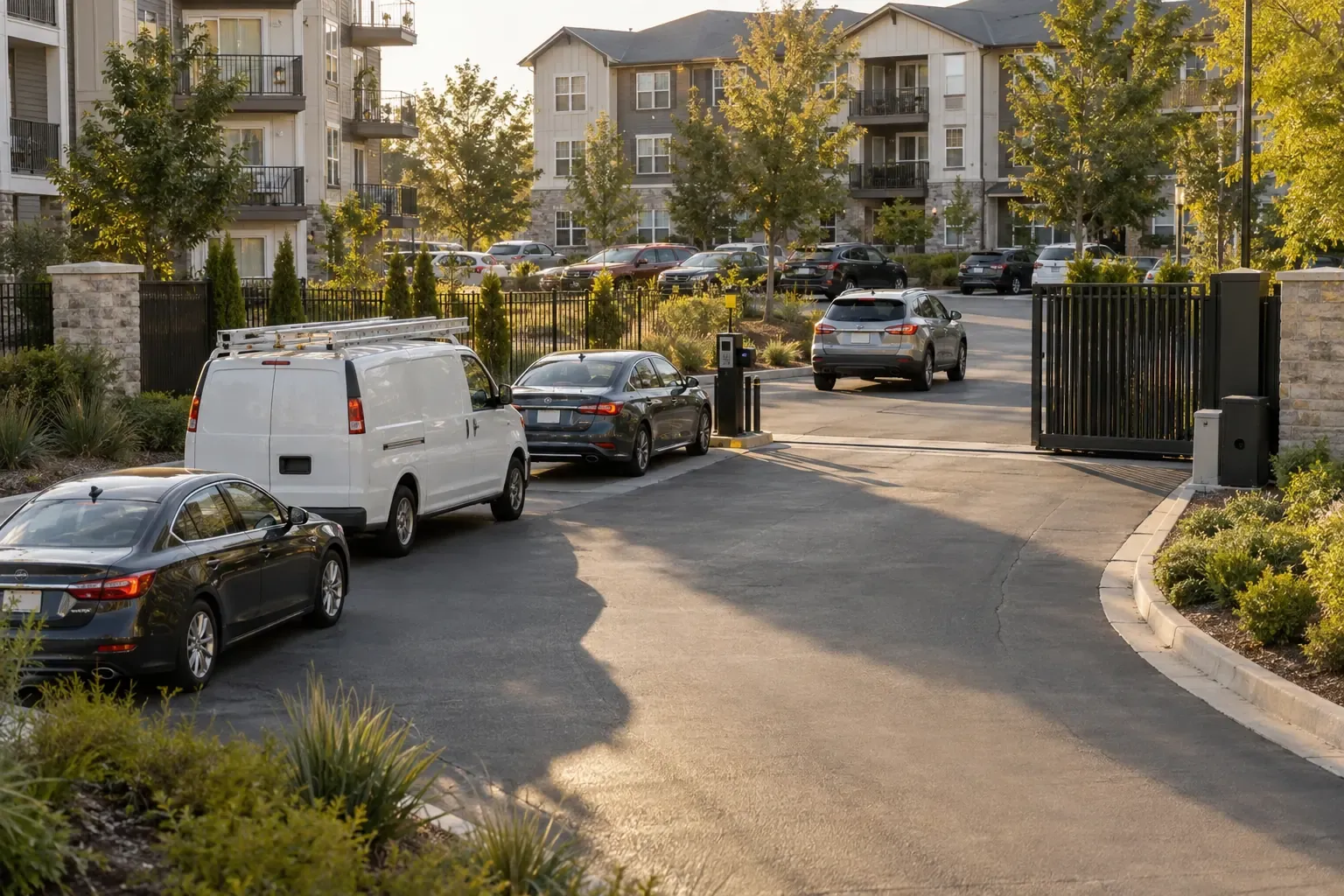
The reason is cycle count. A residential driveway gate opens for one household; the vehicle entrance at an apartment property opens for every resident arriving and leaving, every guest buzzed in, and every delivery driver, landscaper and vendor. Same hardware, a different order of workload — and the industry publishes the thresholds. DASMA classifies gate traffic in cycles per hour for swing and slide gates:
Light traffic
10 cycles per hour
Normal traffic
20 to 30 cycles per hour
High traffic
over 30 cycles per hour
For barrier arms the bands run higher still — commercial parking is rated at 250 to 300 cycles per hour.
Those bands matter because cycles per hour is not a footnote to the specification. DASMA’s guidance treats gate size, gate weight and the number of times the gate must open and close per hour as what together set the duty rating an operator needs. Traffic volume is half of that answer.
So every wear item — rollers, hinges, the chain or belt that drives the gate, the motor that turns it — reaches the same accumulated wear far sooner than the identical part on a residential gate. Not because it is a worse part. Because it has done more work.
That changes how you read a fault. On a house, a failed roller is usually just a failed roller. On a property gate it is a question: is this part at the end of its service life, or is something making it work harder than it should?
That second question is where most commercial gate money gets wasted. Replace the part and the gate runs. Leave whatever was overloading it in place, and you will see the same part again.
The operational side
What downtime actually costs you
Nobody calls because the gate matters. They call because of what the gate stopped doing.
Stuck closed is an access problem
Residents cannot get home, tenants cannot reach their units, trucks cannot reach the dock. The calls start immediately, and they come to you.
Stuck open is a security problem
The one that gets underestimated. The property still looks normal and nothing is visibly broken — but the controlled access residents are paying for is not happening, including overnight. On a multifamily or self-storage property that is the exposure that turns into a serious conversation if something happens while the gate is down.
Intermittent is the worst to manage
It cannot be scheduled around, it generates complaints nobody can reproduce on demand, and it gets dismissed as user error until it fails completely. It is also the most likely to be misdiagnosed, because whoever looks at it may arrive during an hour when the gate is behaving.
There is a second cost that does not show up on the invoice: your time. The mechanical repair is one line of it. The tenant emails, the owner asking what happened, and the expense to justify afterward are most of it — which is why a fast repair that does not explain itself leaves you with the second job still to do.
Four operating patterns
What the property type actually changes
Apartments, HOAs, self-storage and industrial yards are not four labels for the same job. They differ in who uses the gate, how often, and what happens when it stops.
Where the commercial line actually falls
Lower than most people expect. The UL 325 standard treats a housing property as a commercial site — its Class II category — once it reaches “five or more single family units.” A small complex is a commercial gate installation by the standard’s own definition, however residential it feels to manage.
Apartments and multifamily
The highest cycle counts and the least tolerant audience.
Residents expect the gate to work at 2 a.m. Every hour it does not, the complaint volume grows, and the gate stops being a mechanical problem and becomes a management problem.
The entrance is also shared by people with no relationship to each other — residents, guests, vendors, delivery drivers, and anyone tailgating in behind them — so it has to work without anyone’s cooperation.
HOAs and gated communities
Similar traffic to an apartment property, a different decision process.
The repair has to be justified to a board, often at a scheduled meeting, sometimes against a competing bid. What the board is actually deciding is whether the diagnosis is trustworthy — which is why a line reading “gate repair” and then a number gives them nothing to approve except the number.
Self-storage
A distinct operating pattern, because access is the product.
Access is per-tenant and usually keypad-driven, so the entry system is not a convenience — it enforces who is allowed on the property and when. When it fails, you are choosing between locking out paying tenants and leaving the site open.
Industrial and commercial facilities
Yards, warehouses, distribution and secured facilities.
Cycle counts can be enormous and the vehicles are heavier — trucks, trailers, equipment. Gates are wider and heavier, and the operators driving them work nearer the top of their capacity every cycle.
Downtime here is operational, not just inconvenient: a gate that will not open is a yard that cannot receive or dispatch. That makes the real question not the cheapest fix, but the one that does not come back next month.
The split that matters
Three places a commercial gate fault can live
A property gate is three systems sharing one entrance. Telling them apart early keeps a service call from becoming an exploratory one.
①
The gate
The physical structure — frame, hinges, posts, tracks, rollers. Symptoms are mechanical and usually visible or audible: dragging, grinding, sagging, binding at one point in the travel. If a fault repeats in one specific spot every cycle, it is a structure question.
②
The operator
The machine that drives the gate. Its symptoms are behavioural: nothing happens, it hums but does not move, it starts and stops, it reverses without an obvious obstruction, it works intermittently.
③
The access control
The keypad, card reader, telephone entry or intercom that requests entry. Its symptoms are permission-shaped: one credential fails while another works, the device is dead, or the call goes through and nothing happens.
The single most useful test on a commercial property is also the simplest: does the gate work from a different control?
If the gate opens fine from a manual control or a second device but not from the keypad, the gate and operator are working and the problem is on the access side. If it will not move from anything, the entry devices are not the issue no matter how many tenants report the keypad. That alone separates most commercial calls into the right branch before anyone opens a panel.
A commercial reality
Vehicle damage
Commercial gates get hit — heavy traffic, tight turning radii, drivers unfamiliar with the site, and anyone who followed the car ahead through a closing gate.
Impact damage is deceptive in both directions.
A gate that looks badly damaged
It may have taken the impact where it was designed to — bent panel, intact frame, undamaged operator — and be a straightforward structural repair.
A gate that looks fine
It may have absorbed the force through its hinges, posts or track, or passed it into the operator’s drive components — a gate that runs, but drags, binds, or fails weeks later somewhere that seems unrelated to the collision.
So after an impact the diagnosis is not only what is visibly bent. It is whether the gate still travels true through its entire range, whether the posts and hinges are still square, and whether the operator is now working against a load it was not carrying before.
We repair structural gate damage, including on-site welding of frames, hinges and posts, and we repair the mechanical components that impacts commonly take out — hinges, tracks and rollers.
If the gate is down right now
A gate stuck open, stuck closed, or unsafe to be near is an emergency situation. See emergency gate repair for what to do in the first few minutes.
Before the truck arrives
What your on-site staff can safely record
Anything requiring someone to stand in the gate’s path, open the operator enclosure, or touch wiring is technician work — not worth the risk, and it usually destroys the evidence.
Safe to observe from well clear of the gate’s travel, and genuinely useful:
- Does the gate move at all? Not at all, partway, or fully but wrongly — three different problems.
- Does it fail in the same place every time? A fault at a consistent point in the travel usually means something physical is there. An inconsistent one usually does not.
- Does it fail in one direction only? Opening but not closing, or the reverse, narrows the cause substantially.
- Does it work from any other control? The single most valuable line in the report.
- Is it one credential or all of them? One resident’s code failing is a different fault than every code failing.
- What does it sound like? Silence, a hum, a click, grinding, a repeated clunk at one spot — each points somewhere different.
- When did it start, and did anything change? A storm, a power event, an impact, a new gate, a re-graded drive.
- How many tenants have reported it, and since when? This is the part managers already have and technicians rarely get.
Write those down. A gate log that says “opens fine, won’t close, started Tuesday after the storm, fails at the same point every cycle, keypad works normally” has already ruled out most of the possibilities.
Scope
What we repair, and what we install
Plainly, so there is nothing to infer.
Repairs on the gate and operator: gate motors, control boards, hinges, tracks, rollers, and structural weldingof frames, hinges and posts, performed on site.
On the access-control side we install and repair keypads, card readers, telephone entry systems and intercom systems. For access-control equipment those are the two things we do — installation and repair.
We work on sliding and swing gates, and buildcustom gates where a property needs one that does not come off a shelf.
What we don’t offer, and won’t pitch
Maintenance programs and recurring service agreements.Those are not part of what this business does. What is offered is a service call — we come out, diagnose the gate, and tell you what we found.
The decision underneath the repair
Repair, replace, or something upstream
Three different decisions get compressed into the word “repair,” and they carry very different costs.
1: Repair the component
The part failed, the rest of the system is sound, and the fix is contained. Worth confirming rather than assuming, because the same visible symptom shows up in all three situations.
2: Address what the component was fighting
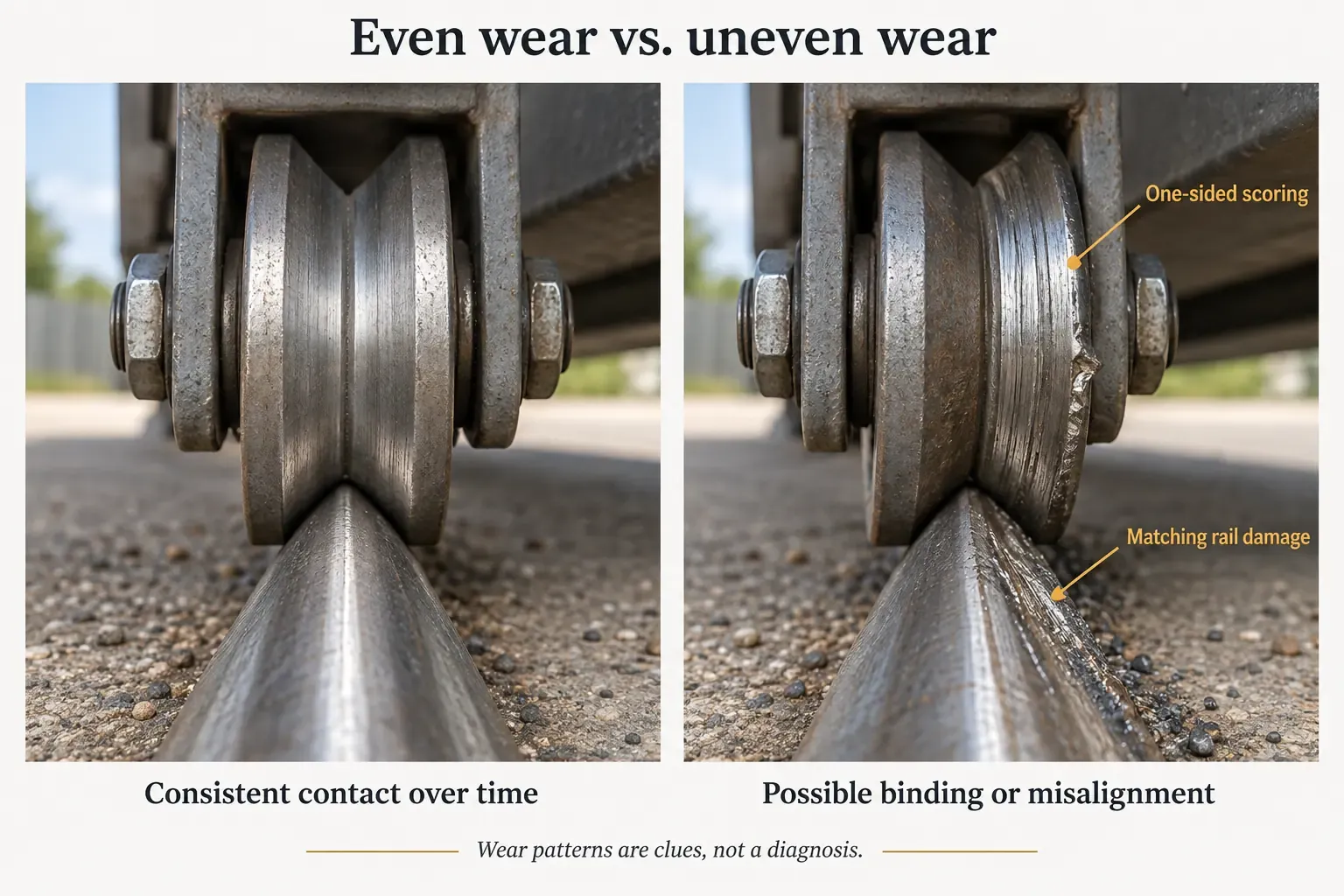
A part that failed early was usually failing against something. A gate out of alignment loads its rollers unevenly; a sagging frame puts its weight on hinges never meant to carry it. The failed part is the messenger, and replacing it alone is a repair with an expiry date on it.
3: Reconsider the application
Sometimes nothing is wrong in the ordinary sense — the entrance simply asks more of the equipment than it was specified to give. Properties change: units get added, a second entrance closes and routes everything through one gate.
On that third one, DASMA notes that “continuous-duty motors are best suited to high-cycle applications” — equipment has an intended workload, and a site can outgrow it. Telling these apart comes from what the gate is doing under load, the wear pattern on the failed part, and whether the entrance is still the geometry it was when the system was installed.
What we can say plainly is which of the three we think you are in, and why — including when the honest answer is that the gate is fine and the entrance has changed around it.
The half nobody writes about
Getting a repair into a work order
The mechanical problem is usually the smaller half of the job. The rest is explaining it to someone who wasn’t there.
When we diagnose a commercial gate, these are the three things worth being clear about:
1: What failed
The specific component, named plainly.
2: Why it failed
Wear at the end of a service life, a load it should not have been carrying, impact damage, or a power event.
3: What it means for the rest of the system
Whether this was contained, or whether it points at something that will produce the next failure.
That third item is the one that changes a budget conversation. A roller that wore out after years of high-cycle service is one kind of expense. A roller that wore out in months because the gate is out of alignment is a symptom — and replacing it alone buys the same failure again.
Free estimates. We will tell you what we find before there is a decision to make.
If this is not your problem
Where to go next
A commercial entrance is several systems at once. Here is where the rest of them live.
- The gate structure itselfAutomatic gate repairSagging, off-track, dragging, welding
- The operatorGate opener repairMotors, control boards, gates that hum, click, or reverse
- Entry devicesGate access controlKeypads, card readers, telephone entry, intercoms
- Down right nowEmergency gate repairStuck open, stuck closed, hit by a vehicle
- Commercial property gatesYou are hereApartment, HOA, self-storage, industrial
Get the gate looked at
Tell us the property type, how many gates are involved, and what the gate is doing. If you have a log of when it started and how it fails, send that too — it usually tells us where to start.
We repair apartment, HOA, self-storage and industrial gates across Fort Worth and the broader DFW area, including Arlington, Dallas, Frisco, Plano, Irving, Lewisville, Carrollton, Garland, Rockwall and McKinney.
Licensed and insured · Fort Worth and the DFW area