
Won't open / won't close
Gate opens but won't close
It swings or slides open on the remote exactly like it always has. Then it sits there. Or it starts to close, thinks better of it, and rolls back open. Nothing about the motor sounds wrong.
That combination — one direction fine, the other refused — is a meaningful clue, and it points away from the motor rather than toward it.
A gate that opens is a gate whose motor turns, whose drive engages, and whose power supply works. All three just proved themselves in front of you. So whatever is stopping the close is something that applies to the closing direction and not the opening one.
There is a reason for that asymmetry. Closing is the direction that can trap a person, a pet or a vehicle, so it is the direction that carries the most protection. Under the UL 325 safety standard a vehicular gate operator must havetwo independent means of entrapment protection for each entrapment zone, and DASMA notes those means are required “in each direction WHERE THERE IS A RISK OF ENTRAPMENT.”
When one of those protections reports something in the way, the operator is not permitted to close the gate. It does not get to weigh the evidence. It refuses.
Which means a gate that will not close can be a gate doing its job correctly on bad information — not a broken machine.
What it means
Six things that produce this exact behavior
Ordered by how cheaply each can be ruled out — the ones you can settle standing in your driveway come first, and the expensive possibility comes last on purpose.
① Something is breaking the safety beam
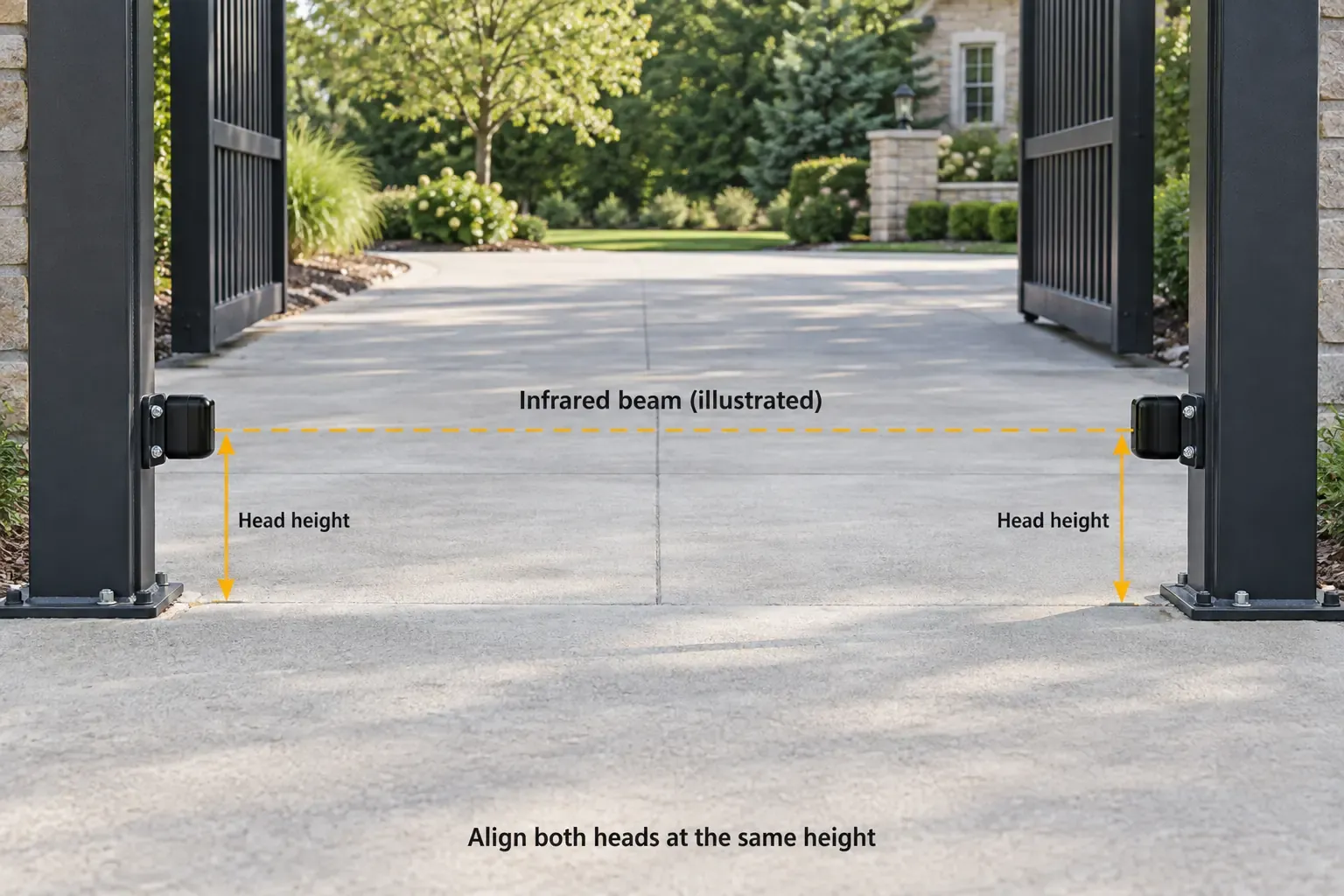
A photo-eye is a pair of units facing each other across the gate opening — one sends an infrared beam, the other watches for it. Break that beam and the operator will not close the gate. It cannot tell a child from a trash bin from a spiderweb strung between the lenses overnight. It only knows the beam stopped arriving.
The gate opens normally and refuses only on close — because the closing direction is the one that can trap something.
② The beam is not being broken, it is not arriving
Same symptom, different fault. A lens caked with dust, pollen or condensation dims the beam below the threshold the receiver needs. A bracket knocked by a mower, a vehicle door or a season of temperature swings drops the two units out of alignment. Low sun striking the receiver head-on can wash out the signal it is trying to read.
Alignment and contamination faults can come and go with weather, time of day, or season — which is what makes them so easy to misread as an intermittent electrical fault.
③ A different safety device is reporting, not the photo-eye
Photo-eyes are not the only entrapment protection a gate can carry. A contact edge along the leading edge of the gate reports physical contact. An in-ground loop reports a vehicle sitting in the gateway. Either will hold a gate open, and neither is visible the way a photo-eye is.
Worth knowing before assuming the photo-eye is at fault: a gate can be refusing on an input from a device you cannot see from the driveway.
④ The operator has latched a safety state and is waiting
Gate operators are required to hold certain safety conditions until something clears them. Where an inherent sensor or a contact edge has stopped or reversed the gate, DASMA notes the automatic close timer stays disabled until it is reset. A gate that used to close itself and now simply stays open may be holding a latched state from an event nobody witnessed.
This one produces a gate that responds to the remote perfectly and just never auto-closes on its own.
⑤ The gate is being asked to move against resistance
Closing can be the harder direction. A sagging swing gate that drops onto its arc, a slide gate with a worn roller or debris in the track, or a hinge that has moved out of square all add load. An operator sensing more force than it expects on close is designed to stop or reverse rather than push through it.
A gate that has been getting slower, noisier or rougher for weeks before it finally refused is pointing at the structure, not the electronics.
⑥ The control board or its settings
A close limit that has drifted, a lost setting, a failed relay, or a board that has taken a surge. This is the cause owners tend to assume first, and it is placed last here for a reason: it is the most expensive to guess at and the only one on this list that cannot be ruled out from the driveway.
It becomes the likely answer once the safety inputs above have been checked and cleared — not before.
Check it yourself
Five things you can safely check
Every one of these is done standing clear of the gate's path, with the gate stationary, without tools and without opening anything. If one of them solves it, you have saved yourself a call — that is a good outcome and it is why this section is here.
Before you start
Stay out of the gate's path and do not reach through it. DASMA states that all gate activation controls must be at least 6 feet from the gate “to reduce the opportunity for ‘reach-through’ injury,” and that pedestrians must stay clear of a vehicular gate's entire travel path. Automatic vehicular gates are not designed for people to walk through.
① Look along the beam path, from outside it
Stand to the side, clear of where the gate travels, and look across the opening at the height of the two photo-eye heads. Look for the obvious: a bin, a branch, a stone, a coiled hose, a parked wheel, a spiderweb. Clearing an object out of the beam path is a fix anyone can make.
Why it helps: Costs nothing and resolves the entire problem when it is the answer.
② Look at the lenses themselves
Each unit has a small lens. If it is dulled with dust, pollen, mud spatter or condensation, that alone can drop the beam below the level the receiver needs. Wiping the outside of a lens with a soft dry cloth is reasonable. Do not open, unscrew, loosen or reposition either unit.
Why it helps: Moving a photo-eye to “fix” the aim is how a small fault becomes a bigger one. Alignment is a setup task, not a cleaning task.
③ Check whether it is time-of-day dependent
If the gate refuses in the late afternoon and behaves at night, that is a strong signal — low sun striking the receiver washes out the beam it is reading. Note the pattern, do not act on it.
Why it helps: The pattern is genuinely diagnostic, and it is information you can gather that a technician arriving at 10am simply cannot.
④ Check for a physical obstruction in the closing path
Look along the track of a slide gate and the arc of a swing gate for gravel, a stone, a shifted paver, or ground that has moved. Again — look, from clear of the path.
Why it helps: A gate stopping on real resistance is behaving correctly. Finding the obstruction can be the whole repair.
⑤ Note exactly what it does, and tell whoever you call
Does it start to close and reverse, or never start? Does it only work while you hold a button? Does it respond to the remote but never close on its own? Did it begin after a storm, a power cut, or a vehicle contact?
Why it helps: These distinctions separate causes that look identical from the driveway. Describing the behavior accurately is the single most useful thing you can do before anyone arrives.
Do not do these
- Do not tape over, unplug, jumper or bypass a safety device to force the gate shut. UL 325 states there “shall be no modification made in the field to bypass, interfere with, or otherwise defeat the monitoring function.” A gate with its protection defeated will close on whatever is in the way.
- Do not open the operator enclosure. There is line-voltage wiring inside, and on many systems a battery and stored energy that do not care whether the breaker is off.
- Do not push, pull or hold the gate through a reversal. If it is reversing, something is telling it to. Overpowering that reading damages drive components and removes the evidence of what caused it.
- Do not realign a photo-eye by hand. Aim is set against the operator's own monitoring. Nudging a head that is reporting correctly can turn a clean fault into an intermittent one that is far harder to trace.
Where it stops being a DIY job
When it needs someone with a meter
If the beam path is clear, the lenses are clean, and there is nothing in the closing path, the remaining possibilities all live behind a cover or inside the wiring. That is the point at which looking harder from the driveway stops producing answers.
Specifically, these need test equipment rather than eyes: confirming whether a photo-eye is actually powered and actually reporting; confirming whether the operator is receiving what the sensor is sending; reading a latched safety state; measuring the force a gate is demanding on close; and checking alignment against the operator's monitoring rather than by eye. Each of those distinguishes between faults that look identical from outside.
It matters because the failure modes here are genuinely easy to confuse, and the expensive mistake runs in one direction: replacing a control board or an operator that was reporting a two-dollar alignment problem correctly the entire time.
If you have reached this point, the service page for this is automatic gate repair. If the gate is stuck open right now and the property is sitting unsecured, that is emergency gate repair instead. If the gate only moves while you hold the button, or it stopped and will not restart at all, that behavior is covered on gate opener repair.
If this is a property you manage
The same symptom at an apartment, HOA or self-storage entrance is a different problem, because a gate that will not close is an open property and every resident call comes to you. Commercial gate repair covers how that gets scoped and documented.
No mystery
What we check, in order
On this particular symptom the order matters more than usual, because step two is where this symptom points first — and steps three and four are where the expensive misdiagnosis happens if you skip it.
① Power and battery
Confirmed first because everything downstream is read through it. An operator on failing battery backup or a sagging supply can produce behavior that imitates a safety fault exactly.
② Safety sensors
On this symptom, the highest-value step. Are the devices present, aligned, clean, reporting, and monitored — and is the operator seeing them the way it expects to?
③ Control board and limit settings
Only once the inputs are known good. A board judged on unverified inputs is a board judged unfairly, and that is how healthy parts get replaced.
④ Mechanical drive
The physical side: what the gate is asking the operator to do. Load, travel, and whether the structure has changed since the day it was set up.
In that order, because that is the order gates fail in. You get a plain-English answer either way — including if the answer turns out to be that a lens needed wiping.
Questions
Frequently asked
Why does my gate open fine but not close?
Closing is the direction that can trap a person or a vehicle, so it carries safety protection that opening may not. When a photo-eye, contact edge or loop reports something in the way, the operator is required to refuse to close. A gate that opens normally and refuses only on close points toward a safety input rather than a mechanical failure — which is why replacing a motor may not fix it.
Can a dirty or misaligned photo-eye stop a gate from closing?
Yes. A photo-eye works by one unit sending an infrared beam to another. Anything that stops the beam arriving — an object in the path, a dulled or contaminated lens, a bracket knocked out of alignment, or low sun striking the receiver — reads to the operator the same way an obstruction does. The operator cannot distinguish between them.
Is it safe to disconnect or tape over a gate safety sensor to make it close?
No. Those devices exist to prevent a gate closing on a person or a vehicle, and UL 325 expressly prohibits field modifications that bypass, interfere with or defeat entrapment protection or its monitoring. A gate forced past a safety device is a gate that will close on whatever is in its path.
Why does my gate only move while I hold the button down?
That is a documented designed behavior, not necessarily a broken part. External entrapment sensors have to be monitored, and where one is missing or faulted the standard requires the operator to fall back to constant-pressure control for the protected direction. So a gate that only moves while you hold the button may be telling you a safety device has dropped out — not that its board has failed. The gate opener repair service page sets out that behavior and three others like it in full.
Does a gate that will not close mean the motor is dead?
Not on its own. A dead motor does not produce a gate that opens perfectly. A gate that completes one direction and refuses the other is demonstrating that the motor, drive and power are all capable of moving it — which points at the inputs governing the closing direction rather than at the motor.
Still refusing to close?
Tell us what it does — whether it starts and reverses or never starts, whether it happens at a particular time of day, and what changed around the time it began. That description narrows it considerably before anyone arrives.
Request a free estimate
Describe what the gate is doing and we will tell you what kind of problem it is.
More gate troubleshooting: gate diagnostic guides · all gate services